
Afghanistan Earthquake Rescue: Helicopters Deployed as Death Toll Surpasses 800
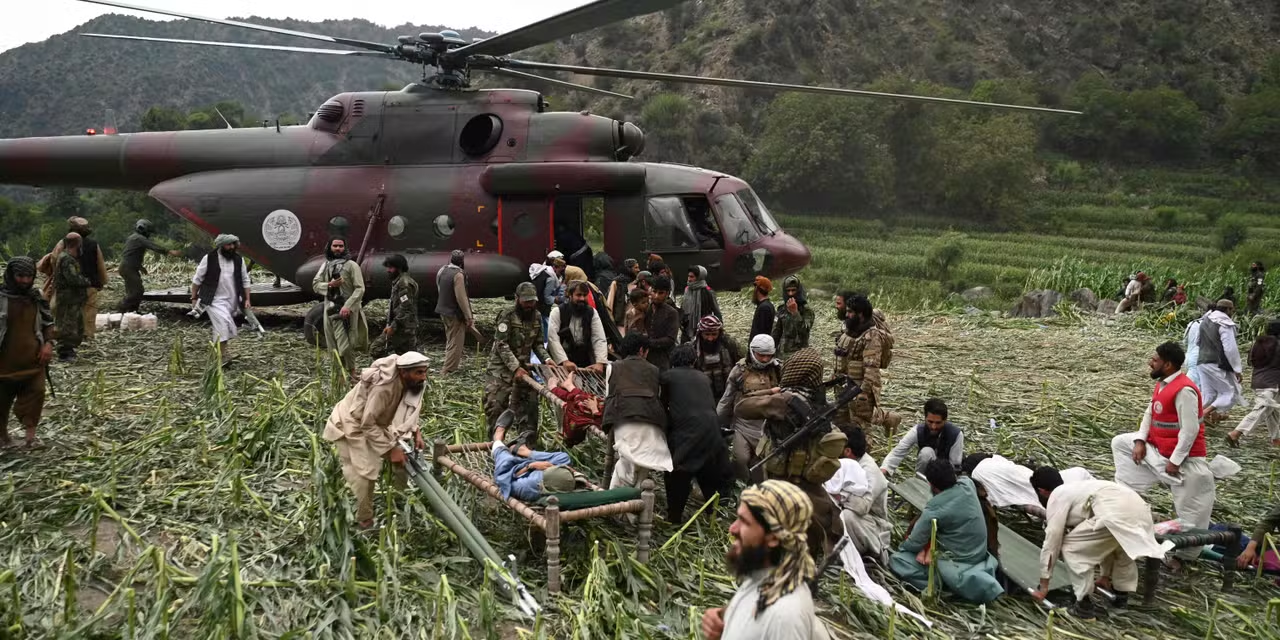
A devastating earthquake has struck Afghanistan, leaving more than 800 people dead and thousands injured, according to initial reports from the Taliban’s disaster management authority. Rescue operations are under way, with helicopter teams leading the effort to reach remote and badly hit villages in the mountainous regions of the country.
This article examines the latest updates, eyewitness accounts, the role of helicopters in the rescue mission, challenges faced by responders, international reactions, and what this disaster means for Afghanistan’s already fragile humanitarian situation.
The Earthquake Strikes
The tremor, measured at magnitude 6.5, struck in the early hours of the morning near the Hindu Kush mountain range. Its epicenter was located close to the border provinces of Badakhshan and Takhar, though tremors were felt across Kabul and as far away as Pakistan and parts of Central Asia.
According to the Taliban’s interior ministry, many of the casualties occurred in rural villages where homes are made of mud and stone, which crumbled instantly under the quake’s force. Local media reported entire families buried alive as roofs collapsed.
Residents in Kabul described scenes of panic. “The ground shook so violently that I thought the whole building would come down,” said Abdul Karim, a shopkeeper who fled into the street with his children.
Casualties and Immediate Impact
By late Monday, officials confirmed that the death toll had surpassed 800, with fears it could rise significantly as rescue operations expand into inaccessible areas. Over 2,000 people have been injured, many of them critically.
Hospitals in Faizabad and Kunduz are struggling to cope with the influx of patients. With limited supplies, doctors have appealed for urgent medical aid, including surgical equipment, blood donations, and medicine for trauma care.
Entire villages have reportedly been flattened. “In some districts, 70 to 80 percent of homes are destroyed,” said a disaster management official.
Helicopter Teams Leading the Rescue
In the mountainous terrain of Afghanistan, helicopters are proving to be lifelines for communities cut off by landslides and blocked roads.
“Without helicopters, many of these areas are unreachable,” explained Ahmadullah Wasiq, a government spokesperson. “Our teams are landing in isolated villages, pulling survivors from rubble, and bringing them to safety.”
Videos shared on social media show helicopters hovering above collapsed homes as crews load stretchers with the injured. In some instances, villagers waved cloths and blankets to signal to pilots where survivors remained trapped.
International Aid and Humanitarian Challenges
While the Taliban has announced its own rescue efforts, international humanitarian agencies are warning of dire challenges. Afghanistan’s healthcare system is already stretched thin after years of conflict and economic collapse. Aid groups like the Red Crescent, Médecins Sans Frontières, and UNICEF are preparing emergency relief packages.
The United Nations Office for the Coordination of Humanitarian Affairs (OCHA) said it was assessing needs and mobilizing response teams. “The people of Afghanistan cannot bear another catastrophe on top of the existing humanitarian crisis,” said a UN spokesperson.
Neighboring Pakistan has expressed readiness to send emergency supplies and medical teams, while India, Iran, and China have all signaled potential assistance. However, sanctions, limited diplomatic recognition of the Taliban government, and logistical hurdles may slow down aid delivery.
Survivors’ Accounts
The most harrowing stories are emerging from survivors who witnessed entire families wiped out.
“My husband was trapped under the rubble. We dug with our hands until neighbors helped us. Many of our relatives did not survive.”
Children are among the hardest hit. Dozens have been orphaned, and temporary shelters are struggling to accommodate the displaced. In one field hospital, volunteers reported children arriving alone, crying for parents who could not be found.
Earthquake Vulnerability in Afghanistan
Poor infrastructure compounds the impact of seismic events, as many homes are built without reinforcement.
The country has experienced a string of deadly earthquakes in recent years, including one in Paktika province in 2022 that killed more than 1,000 people. Experts have long warned that without stronger building codes and preparedness, Afghanistan remains dangerously exposed.
Dr. Farid Haq, a seismologist, noted: “The tragedy is not just the earthquake itself, but the vulnerability of Afghanistan’s people. Poverty, fragile governance, and lack of emergency services turn natural disasters into humanitarian catastrophes.”
Political and Social Dimensions
The Taliban government faces a major test in its ability to coordinate rescue and relief. While it has mobilized its own resources, critics argue that restrictions on NGOs and strained relations with the West are slowing external assistance.
Some residents have voiced frustration at the slow pace of government response. “We waited hours for help to arrive,” said a man from a destroyed village in Badakhshan. “Only when the helicopters came did we see hope.”
The earthquake also adds pressure on Afghanistan’s humanitarian crisis, where millions already face food insecurity, unemployment, and restricted access to healthcare under Taliban rule.
The Road Ahead: Rebuilding and Recovery
With thousands of homes destroyed, shelter will be one of the greatest needs. Winter is approaching, and displaced families risk exposure to freezing conditions.
Humanitarian experts stress that recovery must include rebuilding homes to withstand future quakes. However, with Afghanistan’s fragile economy, the ability to fund such reconstruction remains uncertain.
There are also concerns about mental health support for survivors. Many Afghans are traumatized, not only by the quake itself but by the cumulative effects of years of war, poverty, and repeated disasters.
Global Reactions
World leaders have expressed condolences. The UN Secretary-General called for “urgent solidarity with the Afghan people,” while the European Union said it was exploring emergency funding for relief operations.
International NGOs, meanwhile, urged governments to put politics aside and prioritize humanitarian assistance. “The Afghan people should not be punished for political realities,” said Amnesty International. “Lives must come first.”
Conclusion
The Afghanistan earthquake that killed more than 800 people has once again highlighted the fragility of a nation caught between natural disasters and ongoing humanitarian crises. Helicopter rescue teams are making life-saving interventions, but the sheer scale of devastation demands urgent international cooperation.
world step in with the assistance it so desperately needs?
For now, the whir of helicopter blades across Afghanistan’s mountains offers the faint sound of hope amid the rubble.

